
A conventional approach to automating the supply chain is to deploy an application at the distributor’s end and connect it online with the parent company’s ERP system.
In this model, distributors are required to manually enter sales information, such as which products were sold to specific retailers. This data is then transmitted to the parent company’s ERP for further processing.
While this approach may appear straightforward, it creates a significant challenge: most distributors already use Tally to manage their accounting and record sales transactions. Asking them to enter the same information into another application means duplicating their work without providing a clear additional benefit.
This duplication can create resistance among distributors and negatively impact user adoption. Therefore, a successful supply chain solution must integrate with the distributor’s existing accounting system and eliminate duplicate data entry, making the process simpler and more beneficial for the end user.
Tally is widely preferred by distributors for managing their accounting and sales operations. This makes it possible to provide a customised version of Tally that meets both the distributor’s needs and the parent company’s business requirements.
With a suitable add-on, information entered into Tally can be automatically captured and transferred to the parent company’s ERP system whenever an internet connection is available. The process works seamlessly in the background, allowing distributors to continue using Tally without disruption, even while data synchronization is taking place.
The solution eliminates duplicate data entry and reduces the additional effort required from channel partners. It can also provide distributors with useful information such as their available credit limit with the parent company and the credit limits of their respective retailers, making the system beneficial for both sides.
This approach makes real-time visibility of product movement across the supply chain practical without forcing distributors to change their existing workflows.
The real innovation lies in designing solutions that work around practical business challenges rather than creating additional complexity—integrating technology into existing processes to solve problems efficiently and create value for every stakeholder.
TallyPrime is well-suited for managing supply chain operations across a wide range of industries, including:
Advantages for the Parent Company
A TallyPrime-based supply chain solution can provide the parent company with greater control, visibility, and efficiency across its distributor and dealer network.
Advantages for Distributors
Using TallyPrime as a Supply Chain Management Solution enables distributors to manage their complete business cycle within a single, integrated system.
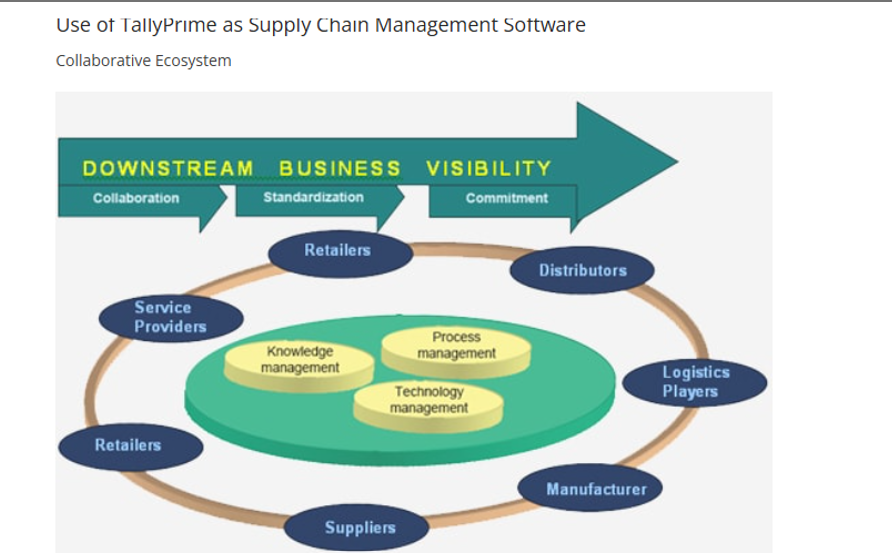
TallyPrime as Supply Chain Management Software
Collaborative Ecosystem
take below image reference from AKSN Infotech and also create this type of image and add after “collaborative Ecosystem”. And give enquiry button after that
Tally ERP for Schools & Colleges
An Educational ERP Solution designed to simplify the day-to-day management of educational institutions while seamlessly handling financial accounting and payroll operations. Built on the simplicity and familiarity of Tally, the solution requires minimal training, making it easy for existing Tally users to adopt.
The solution offers key functionalities such as Admission Management, Student Management, Attendance Management, Examination Management, and other essential features to streamline academic and administrative processes.
By bringing these functions together in one integrated platform, the Educational ERP helps institutions improve operational efficiency, simplify administration, and manage their financial and academic activities more effectively.
The Pre-Admission Management module simplifies the admission process by reducing dependence on physical paperwork. Applicant documents can be digitally scanned, uploaded, and attached directly to their records within the system, making documentation easier to manage, access, and retrieve.
This helps educational institutions reduce paperwork, improve record accuracy, and streamline the overall pre-admission process.
The Student Reporting & Documentation module enables institutions to generate detailed reports based on class, subject, division, caste, and other relevant student parameters.
It also simplifies the creation of essential student documents, including:
The Fees Management System provides a structured and efficient way to manage student fee collection and records. It allows institutions to define fee structures based on each student’s standard, category, and other applicable criteria.
Key features include:
Accurate and organised fee records
The Examination & Marks Management module helps educational institutions efficiently manage student performance and examination records.
It enables institutions to record and manage individual and group subject marks according to specific board standards, with detailed views available at both student-wise and class-wise levels.
The Transportation Management module simplifies the process of managing student transportation and related fee collection. It allows institutions to define routes, pick-up and drop-off points, and assign them to individual students.
Transportation fees can then be automatically managed based on the assigned route and pick-up/drop-off details, reducing manual effort and improving accuracy.
The Library Management System provides an organised way to manage books and library records. Details such as book title, category, author, year of publication, and other relevant information can be recorded and maintained within the system.
Each book can be assigned a unique serial number and barcode, which can be printed and attached to the book for easy identification and tracking.
Tally.ERP 9 provides an integrated payroll management solution designed to simplify salary processing and statutory compliance. It supports essential payroll requirements, including Income Tax, Provident Fund (PF), and Employee State Insurance Corporation (ESIC) compliance.
The SMS Communication Module enables educational institutions to keep parents informed through timely notifications and acknowledgements.
It can send SMS notifications for: